Monday, January 5, 2009

amazing biking videos!

crazy mountail bike trail! watch this!


amazing bmx rider! watch this!

bike brake systems..

Brake systems are used to slow down or stop the motion of a bike. There are mainly five types of brake systems: rim brakes, disc brakes, drum brakes, coaster brikes and spoon brakes. However, the commonly used today are the rim brakes and the disc brakes. 

In rim brakes, the braking force is applied through the brake lever by squeezing it. This causes the friction pads to contact the rim of the rotating wheel, thus slowing it or stopping the bike. Pictures below are among the many sub-types of rim brakes.  


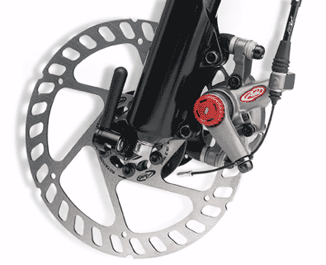
In disc brakes, there is a metal disc attached to the wheel hub that rotates with the wheel. Callipers are attached to the frame or fork along with pads that squeeze together on the disc. There are two types of disc brake: mechanical and hydraulic. Mechanical disc brakes are almost always cheaper, but have less modulation, and may accumulate dirt in the cable lines since the cable is usually open to the outside. On the other hand, hydraulic disc brakes use fluid from a reservoir, pushed through a hose, to actuate the pistons in the disc calliper, that actuate the pads. The first picture below is a mechanical disc brake and the second one is a hydraulic disc brake. 


- wikipedia

Sunday, January 4, 2009

anatomy of a mountain bike..

  • Bottom Bracket -  This attaches the crankset to the body of a bike. It contains a spindle to which the crankset is attached and the bearings that allow the spindle and cranks to rotate. 


  • Brake cable -  Cable connecting the brake lever to the brake mechanism. 


  • Brake lever -  The lever on the handlebar used to activate the brakes. The left side is for the front brake and the right side is for the rear brake. 


  • Chain -  A roller chain that transfers power from the pedals to the drive-wheel of a bicycle thus propelling it. 


  • Chainring -  The toothed rings that attach to the crank to hold the chain. 


  • Crank -  The lever or "arm" which connects the pedal to the bottom bracket. 


  • Derailleur -  The device which moves the chain from one chainring to another inorder to shift gears. 


  • Downtube -  Part of the frame. The tube which runs diagonally from the head tube (supporting the handlebars) to the bottom bracket. Above this is the top tube, which runs from the head tube to the seat. 


  • Front shock -  A suspension system on the front fork which allows the bike to absorb shocks without transmitting them to the rider. 


  • Handlebar -  The horizontal bar located at the front of the bike which is used to steer, and which will contain the shifters and break levers and any other items a cyclist wishes to have within easy reach. 


  • Headset -  The mechanism in front of the frame that connects the front fork to the stem and handlebars. 


  • Hub -  The center part of the wheel that the spokes are attached to. 


  • Pedal -   A short metal bar on which to put your foot, in order to propel the bicyle. The pedal is attached to the crank. 


  • Rear shock -   The shock absorber for the rear tire on dual suspension type bikes. 


  • Rim -   The metal ring that holds the spokes on the inside and the tire to the outside. 


  • Saddle -   The seat. 


  • Seat post -   The tubular support to which the saddle is connected. 


  • Skewer -   A metal rod that attaches the wheel to the frame of the bicycle.  


  • Spokes -   The thick wires that join the hub to the rim.  


  • Stem -   A piece that attaches the handlebar to the steering tube.  


Saturday, January 3, 2009

bikeradar's top 5 mountain bikes of 2008..

5. On-One Lynskey Ti 456 


4. Giant Reign X1 


3. Rockhopper Pro Disc 


2. GT Avalanche Disc 


1. Specialized Pitch Pro 


- bikeradar.com

Friday, January 2, 2009

types of mountain bike..

Basically, there are five different types of Mountain Bikes: cross country, trail, downhill, freeride, and dirt jump. Each type is designed to tackle different kinds of terrain and obstacles and it has its own advantages and disadvantages. In choosing the right Mountain Bike, it is best to know first where you are going to ride and what kinds of obstacles you are going to face while riding. It all boils down to what you want and need.
  • Cross Country Mountain Bikes - Also referred to as XC bikes, Cross Country Mountain Bikes are designed for off-road trails with minimal to moderate obstacles. They can also be used for climbs and descents. XC bikes are made of the most lightweight materials (they weigh between 20-30 pounds) in order to go as fast as possible in all natural conditions. Suspension often comes in the form of air shocks. These bikes are usually more rigid than those of other Mountain Bikes. XC bikes are divided into two sub-types (according to suspension):

Hardtail Mountain Bikes 


These are bikes without rear suspension integrated into the frame. However, to improve comfort, bike suspension forks may be added as an upgrade. Most Mountain Bikes nowadays come standard with a suspension fork. Hardtail bikes weigh 2-3 pounds less than the lightest full-suspension Mountain Bikes. An advantage that a hardtail has over a full-suspension Mountain Bike is that during sprints, you don't waste energy. With full-suspension bikes, you will get this bouncing feeling when you get off the bike saddle. Hardtail frames do have an amount of shock-absorbing characteristic due to the improved materials used for the seatstay and chainstay. Starting out with a hardtail Mountain Bike is not a bad move. You will save on a lot of extra weight and you will be able to have good pedaling technique without the bouncing feeling. Lastly, hardtails are more durable than full-suspension bikes and require less maintenance.

Full-suspension Mountain Bikes


These come with both front fork suspension and rear suspension integrated in the bike frame. These bikes somewhat resemble a motorcycle. They offer much more riding comfort than hardtail but weighs more than the mid-weight hardtails. Due to advances in technology, full-suspension maintenance has become easier. Some bike suspension companies have come out with suspension lock-out. This gives a full-suspension bike a stiff rear similar to that of a hardtail. This is advantageous during off the saddle climbs and sprints to the finish.

  • Trail Mountain Bikes 


These are basically a modification to Cross Country Mountain Bikes, with softer suspension systems to handle harder and more technical obstacles. The only downside to this type is that pedaling may require more effort from the rider because of the increased suspension travel.

  • Downhill Mountain Bikes

As the name suggests, Downhill Mountain Bikes are designed for downhill trails and race courses with steep drops. They have more suspension travel than any other type of Mountain Bike. These tend to be heavier (over 40 pounds), but are made as light as possible to make them suitable for racing. Since they are built for fast downhill runs, they are very hard to use for climbs. They are often equipped with hydraulic disc brakes to help them stop during high speeds.

  • Freeride Mountain Bikes

These look somewhat like Downhill Mountain Bikes, can weigh almost as much, but are designed to be easier to pedal. Freeride Mountain Bikes are made to function both as a Cross Country and a Downhill Mountain Bike, but may not perform as efficiently as the two when it comes to their respective features.

  • Dirt Jump Mountain Bikes

These bikes are used for hitting jumps as well as for street riding and slalom races. Some people refer to Dirt Jump Mountain Bikes as oversized BMX bikes that have front suspension. They are typically made of very strong materials to be able to take the impact of jumps and their suspension systems are just a tad softer than those of Cross Country Mountain Bikes.

To wrap it all up, the different types of Mountain Bikes are Cross Country or XC, Trail, Downhill, Freeride, and Dirt jump. If you are a beginner in this sport, it is advisable to go with a hardtail XC bike, since this type can do almost all things that mountain bikes are made to do, and it comes at a lower price. However, it is also wise to consider the specific type of riding you want to do. If you want to go for fast downhill races, then by all means get a downhill type. If street riding and jumps are your thing, then the dirt jump is the one for you. Just take note of each type’s advantages and disadvantages when buying a Mountain Bike.

- ABC-of-mountain biking.com