Monday, April 13, 2009

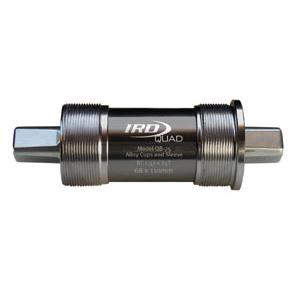
bottom bracket: interface types

Square Taper
This is currently the most popular design by far. This interface consists of a spindle with square tapered ends which fit into square tapered holes in each crank. Tightening the two together creates a relatively efficient and simple interface.


Octalink


This system was designed by Shimano. The Octalink system provided a greater contact area between crank and spindle, so it had a stiffer interface. Octalink exists in the marketplace in two variants, Octalink v1 and Octalink v2. The difference between the two can be seen by the depth of mounting grooves on the bottom bracket spindle. XTR, 105, Ultegra 6500 and Dura Ace 7700 cranksets mate to version one bottom brackets, while more recent mountain bike designs use the deeper-grooved version two. The system is proprietary and protected by Shimano patents and licence fees, thus relatively few companies aside from Shimano produce Octalink cranksets. Many competitors have adopted the square taper and ISIS designs as an alternative. In use, Octalink has been shown to loosen because it is not a taper-fit but merely a tight spline fit. Reverse torque loads can cause the crank bolt to undo, and the crank can be irreparably damaged if this is not checked.

ISIS Drive

ISIS Drive, the International Splined Interface Standard, is an open standard splined specification for the interface between a bicycle crankset and the bottom bracket spindle. It was created by King Cycle Group, Truvativ, and Race Face in response to the proprietary Shimano Octalink splined bottom bracket standard. Because the Shimano splined interface is covered by patents, the ISIS Group created the standard and put it in the public domain so that other companies could make interoperable components. As the standards are separate, parts made for one are incompatible with those made from the other; an Octalink-standard bottom bracket (8 spline) cannot connect to an ISIS crankset (10 spline) and vice versa. One shortcoming in the design of the ISIS bottom bracket is the decreased bearing life compared to square taper bottom brackets. This is because it uses a larger diameter spindle in the same sized shell, so the bearings are smaller. Arguably, it was this shortcoming that lead to the development of external bearing designs.

Outboard / External Bearing

Many current designs are now using an integrated bottom bracket with outboard bearings. This is an attempt to address several issues associated with weight and stiffness. Because of the relatively small 1.37" (36 mm for shells threaded to the Italian standard) diameter shell, designs that place the bearings inside the shell can either have large bearings and a thinner spindle, which lacks stiffness, or smaller bearings and a thicker spindle (such as the original Shimano Octalink), which is stiff but less durable. External bearings allow for a large diameter (hence stiff) and hollow (hence light) bottom bracket spindle. They also offer more distance between the two bearing surfaces which contributes to stiffness while allowing lighter components.

source: http://en.wikipedia.org/wiki/Bottom_bracket

Tuesday, March 10, 2009

disc brake systems..


There are two main types of disc brake: mechanical (cable-actuated) and hydraulic. Mechanical disc brakes are almost always cheaper, but have less modulation, and may accumulate dirt in the cable lines since the cable is usually open to the outside.

Hydraulic disc brakes use fluid from a reservoir, pushed through a hose, to actuate the pistons in the disc calliper, that actuate the pads. They are better at excluding contaminants, but are difficult to repair on the trail, since they require fairly specialized tools. The brake lines occasionally require bleeding to remove air bubbles, whereas mechanical disc brakes rarely fail completely.

Also, the hydraulic fluid may boil on steep, continuous downhills. This is due to heat build up in the disc and pads and can cause the brake to lose its ability to transmit force ("brake fade") through incompressible fluids, since some of it has become a gas, which is compressible. To avoid this problem, 203 mm (8 inch) diameter disc rotors have become common on downhill bikes. Larger rotors require less calliper pressure for equal stopping power, dissipate heat more quickly, and have a larger amount of mass to absorb heat. Two types of brake fluid are used today: mineral oil and DOT fluid. Mineral oil is generally inert, while DOT is corrosive to frame paint but has a higher boiling point. Using the wrong fluid may cause the seals to swell or be corroded.


-wikipedia

Sunday, March 1, 2009

saddle tips..

Saturday, February 21, 2009

Tuesday, February 10, 2009

world's most expensive bike wheel..


Lew Racing proudly trumpets their Pro VT-1 as “the strongest 880 gram wheel set in the world PERIOD.” The laminate is created through a born and carbon combination process called DEX-LCM, developed by Lew Aerospace for the Department of Defense. Even the spokes are aerodynamic, using a NACA (National Advisory Committee for Aeronautics) airfoil design. Despite weighing only 3 grams apiece, the Pro VT-1’s spokes are actually stronger than those of a normal bicycle wheel.

An 8-spoke version of the VT-1 was ridden to 4th place by French cyclist Jeannie Longo-Ciprelli in the 2008 Olympics. While this set could only support a rider up to 165 lbs, a standard set of Pro VT-1 wheels can support up to 185 lbs.

The world’s most expensive bicycle wheels can be purchased for $5,495. The wheels can be customized, however, up to $15,292. Options include the ability to support up to 500 lbs and an extended 4 year warranty.


- most-expensive.net