Wednesday, November 25, 2009

2010 FOX LAUNCH PRO KNEE PAD


The Launch Pro Knee Pad is the next evolution to knee protection from Fox.

Features:

* Silicone gripper behind the knee to keep the pad in place. 

* Perforated neoprene for breathability. 

* Pre-curved ergonomic fit 

* Elastic strapping top and bottom to keep the pad in place.

iligan city downhill race (09.27.09)


Tuesday, May 12, 2009

mixing/matching tires

Most bikes come with identical tires front and rear. This is all right for general use, but if you want to optimize your bike, you should consider using different tires front and rear. The front and rear tires have different loadings and different requirements.

Narrower Front, Wider Rear

If lightness is the primary goal, tire width/weight is limited by the risk of pinch cut flats, a.k.a. "snake bites." Since there is more weight carried on the rear tire, you can get away with a slightly narrower tire in front than you can in back.

Wider Front, Narrower Rear

A wider front tire makes sense in many applications, however, when handling and ride comfort are considered. A wider tire will generally provide better cornering traction than a narrower one, assuming appropriate inflation pressure. 


A wider tire also provides superior shock absorbency. I personally prefer a slightly wider tire in front, since I suffer from some wrist discomfort on occasion.

Off-Road Issues

Bikes that are used some of the time on loose surfaces often benefit from a wider front tire, with a fairly agressive tread, coupled with a somewhat narrower, smoother rear tire. 

The wide, knobby front tire will provide the all-important front wheel traction. If your front tire skids, it almost always leads to a crash. For riding in soft conditions, such as sand or mud, a wide front tire is essential. If the front tire sinks in and gets bogged down, you're stuck. If the front tire rolls through a soft patch OK, you can generally power the rear through to follow it.

The narrower, smoother rear tire will have lower rolling resistance. Since most of the weight is carried by the rear tire, rolling resistance is more important on the rear than the front. If the rear tire slips, in most cases the worst that will happen is that you'll have to get off and walk.

This is a great idea that developed out of BMX racing.

Some mountain bike tires come in matched sets, with diffrerent tread front/rear. The front tires tend to have the knobs set up more or less parallel to the direction of travel, for improved lateral grip and better steering control. The rears tend to have transverse knobs for driving/braking traction.

source: http://www.sheldonbrown.com/tires.html

Monday, April 13, 2009

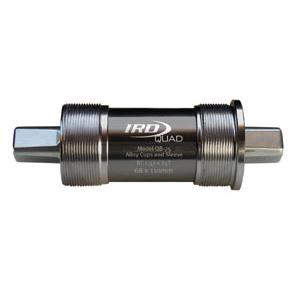
bottom bracket: interface types

Square Taper
This is currently the most popular design by far. This interface consists of a spindle with square tapered ends which fit into square tapered holes in each crank. Tightening the two together creates a relatively efficient and simple interface.


Octalink


This system was designed by Shimano. The Octalink system provided a greater contact area between crank and spindle, so it had a stiffer interface. Octalink exists in the marketplace in two variants, Octalink v1 and Octalink v2. The difference between the two can be seen by the depth of mounting grooves on the bottom bracket spindle. XTR, 105, Ultegra 6500 and Dura Ace 7700 cranksets mate to version one bottom brackets, while more recent mountain bike designs use the deeper-grooved version two. The system is proprietary and protected by Shimano patents and licence fees, thus relatively few companies aside from Shimano produce Octalink cranksets. Many competitors have adopted the square taper and ISIS designs as an alternative. In use, Octalink has been shown to loosen because it is not a taper-fit but merely a tight spline fit. Reverse torque loads can cause the crank bolt to undo, and the crank can be irreparably damaged if this is not checked.

ISIS Drive

ISIS Drive, the International Splined Interface Standard, is an open standard splined specification for the interface between a bicycle crankset and the bottom bracket spindle. It was created by King Cycle Group, Truvativ, and Race Face in response to the proprietary Shimano Octalink splined bottom bracket standard. Because the Shimano splined interface is covered by patents, the ISIS Group created the standard and put it in the public domain so that other companies could make interoperable components. As the standards are separate, parts made for one are incompatible with those made from the other; an Octalink-standard bottom bracket (8 spline) cannot connect to an ISIS crankset (10 spline) and vice versa. One shortcoming in the design of the ISIS bottom bracket is the decreased bearing life compared to square taper bottom brackets. This is because it uses a larger diameter spindle in the same sized shell, so the bearings are smaller. Arguably, it was this shortcoming that lead to the development of external bearing designs.

Outboard / External Bearing

Many current designs are now using an integrated bottom bracket with outboard bearings. This is an attempt to address several issues associated with weight and stiffness. Because of the relatively small 1.37" (36 mm for shells threaded to the Italian standard) diameter shell, designs that place the bearings inside the shell can either have large bearings and a thinner spindle, which lacks stiffness, or smaller bearings and a thicker spindle (such as the original Shimano Octalink), which is stiff but less durable. External bearings allow for a large diameter (hence stiff) and hollow (hence light) bottom bracket spindle. They also offer more distance between the two bearing surfaces which contributes to stiffness while allowing lighter components.

source: http://en.wikipedia.org/wiki/Bottom_bracket

Tuesday, March 10, 2009

disc brake systems..


There are two main types of disc brake: mechanical (cable-actuated) and hydraulic. Mechanical disc brakes are almost always cheaper, but have less modulation, and may accumulate dirt in the cable lines since the cable is usually open to the outside.

Hydraulic disc brakes use fluid from a reservoir, pushed through a hose, to actuate the pistons in the disc calliper, that actuate the pads. They are better at excluding contaminants, but are difficult to repair on the trail, since they require fairly specialized tools. The brake lines occasionally require bleeding to remove air bubbles, whereas mechanical disc brakes rarely fail completely.

Also, the hydraulic fluid may boil on steep, continuous downhills. This is due to heat build up in the disc and pads and can cause the brake to lose its ability to transmit force ("brake fade") through incompressible fluids, since some of it has become a gas, which is compressible. To avoid this problem, 203 mm (8 inch) diameter disc rotors have become common on downhill bikes. Larger rotors require less calliper pressure for equal stopping power, dissipate heat more quickly, and have a larger amount of mass to absorb heat. Two types of brake fluid are used today: mineral oil and DOT fluid. Mineral oil is generally inert, while DOT is corrosive to frame paint but has a higher boiling point. Using the wrong fluid may cause the seals to swell or be corroded.


-wikipedia